


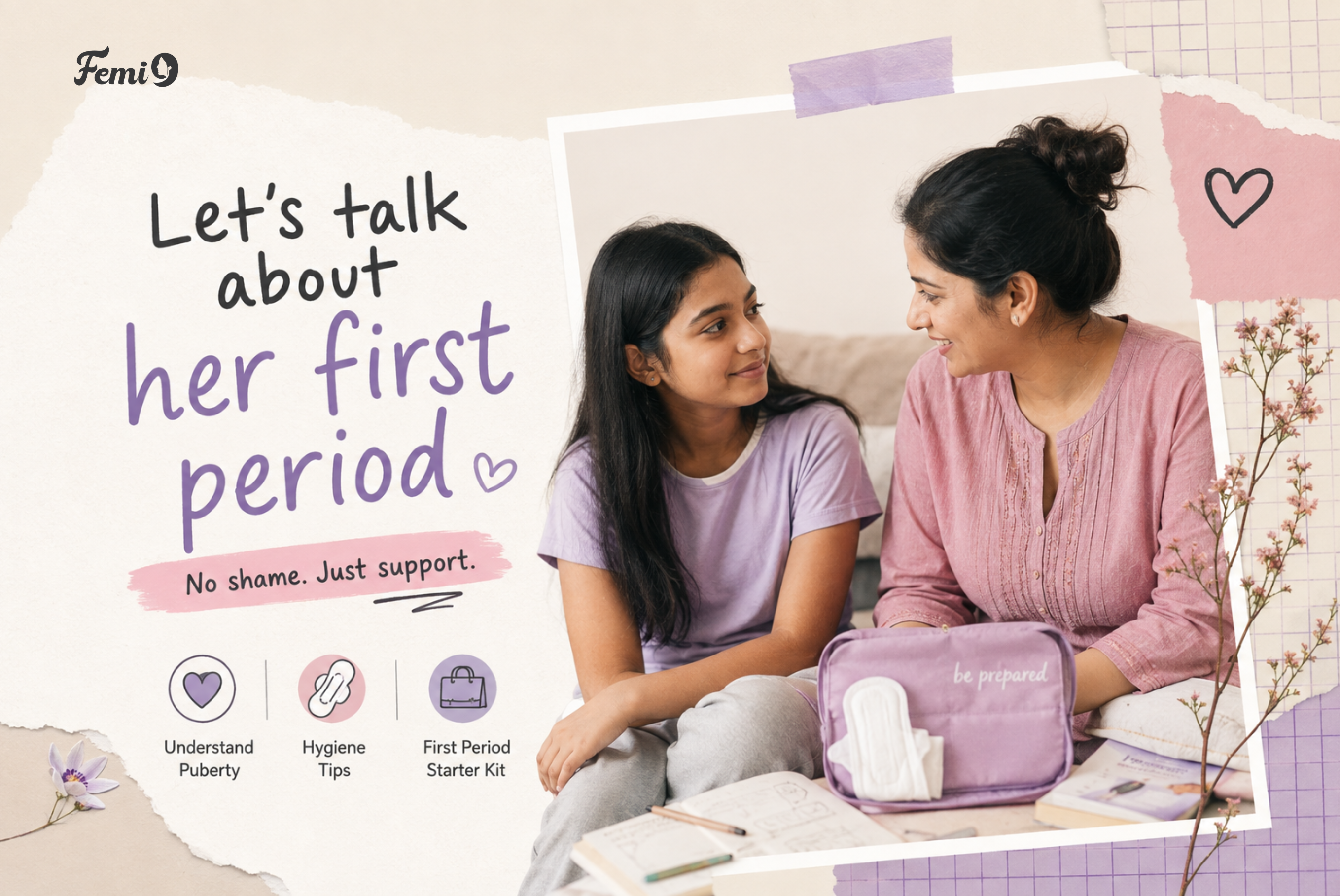
Maybe she is nine and has started asking why there are sanitary pads in your bathroom.
Maybe she is eleven and quietly changing the subject whenever puberty comes up.
Or maybe her first period has already arrived, and she is standing in front of you frightened, embarrassed, or simply unsure of what is happening to her body.
In that moment, she probably does not need a perfect explanation. She needs you.
Learning how to talk to your daughter about periods is not simply about explaining menstruation. It is about deciding what voice she will hear in her head when she thinks about her body for years to come.
Will periods feel like something secret, dirty or embarrassing? Or will she understand that they are a normal part of growing up and something she can manage confidently?
This first-period guide will help you start that conversation gently. We will cover what to explain, when to begin, first-period signs, menstrual hygiene, choosing her first sanitary pad, building a simple period kit and, most importantly, helping your daughter know that she never has to feel ashamed of her period.
The First Period Conversation Is Bigger Than the Period
Think back to when you first learned about menstruation.
Did someone sit with you and explain it calmly? Or did you learn through a whispered conversation with a friend? Perhaps a teacher explained it. Perhaps you noticed blood one day and panicked.
For many women, the conversation was almost over before it began. But your daughter's experience can be different.
UNICEF encourages parents to introduce periods through small, honest conversations about puberty rather than waiting for the first period to arrive. Girls experience several physical changes before menstruation, and knowing what is happening can make those changes feel much less frightening.
Your daughter does not need one serious 'period talk.' She needs to know that periods are a subject she can keep talking to you about.
UNICEF: Talking About Periods at Home
When Should You Talk to Your Daughter About Her First Period?
Do not wait for blood on her underwear. The best first-period conversation usually happens before the first period.
Puberty starts at different ages. According to NHS guidance, periods commonly begin around age 12, although they can start earlier or later. Instead of choosing one specific birthday for 'the talk,' pay attention to her development and questions.
Common Signs Her First Period May Be Getting Closer
· Breast development
· Pubic or underarm hair
· Body odour
· Growth spurts
· Acne or oilier skin
· Vaginal discharge
· Changes in emotions or mood
· Occasional abdominal discomfort
These changes do not predict an exact date, but they create natural opportunities to talk about puberty without turning the conversation into a warning.
You can say: 'Your body is growing and changing. One of the changes that happens for girls is getting a period. When it happens, you can always come to me. I'll show you exactly what to do.'
How to Talk to Your Daughter About Periods Without Making Her Uncomfortable
1. Start Small Instead of Giving Her a Biology Lecture
Periods can enter ordinary conversations. If she sees sanitary pads while you are shopping, explain what they are. If menstruation appears in a movie, advertisement or school lesson, ask what she already knows. Small conversations make periods ordinary, and ordinary things are much harder to feel ashamed of.
2. Ask What She Already Knows
Before explaining everything, ask: 'What have you heard about periods?' Children hear information from friends, classmates, siblings, school, YouTube and social media. Some of it will be correct and some may be wrong.
· Periods are an illness
· Period blood is dirty
· Girls cannot exercise during menstruation
· Everyone can tell when someone is wearing a sanitary pad
Do not laugh at these beliefs. Correct them calmly. The moment she feels foolish for asking one question may be the moment she decides not to ask the next one.
What Should You Tell Your Daughter About Her First Period?
Keep the explanation simple: a period is a normal part of the menstrual cycle. The body prepares the uterus for a possible pregnancy, and when pregnancy does not happen, the lining leaves the body as menstrual blood.
· Periods are normal.
· Period blood is not dirty.
· Early cycles may not arrive on exactly the same date every month.
· Cramps and other physical changes can happen.
· She can still attend school and do normal activities when she feels comfortable.
· Different period products are available.
· She should tell a trusted adult if something worries her.
· She never needs to hide her period from you.
The goal is not for her to remember a textbook. The goal is for her to think: 'I know what this is, and I know who I can talk to.'
Tell Her What the First Period Can Actually Look Like
Many girls imagine their first period will suddenly look like heavy, bright-red bleeding. Explain that the first flow can look different from person to person.
· A small brown mark
· Dark red spotting
· Light bleeding
· A heavier flow
· Bleeding that becomes stronger after the first day
Teach her one practical sentence for school or travel: 'I think I've started my period. Can you help me?' Practising those words can make a stressful moment much easier.
Teach Menstrual Hygiene Without Making Her Fear Her Body
Good menstrual hygiene should feel like self-care, not a list of warnings.
· Wash hands before and after changing a pad.
· Change sanitary pads regularly and sooner if saturated or uncomfortable.
· Wash the external genital area gently with water during bathing.
· Avoid heavily fragranced products if they irritate her skin.
· Wear clean, breathable underwear.
· Wrap used sanitary pads properly before disposal.
· Carry spare pads when going to school or travelling.
· Tell a trusted adult about persistent itching, severe irritation or unusual discomfort.
Internal reading: Femi9 Menstrual Hygiene Guide
Choosing Sanitary Pads for Her First Period
For many teenagers, sanitary pads are one of the easiest products to begin with because they are external and straightforward to use. When choosing sanitary pads for teenage girls, focus on practical comfort rather than making the shelf feel complicated.
Softness and Skin Comfort
A teenager using her first pad may already feel unusually aware of everything happening around her body. A soft, breathable top layer can help make the experience less distracting, especially if she has sensitive skin.
Correct Size
Choose the size based on her flow and activity. A smaller option may suit lighter flow or spotting, while a longer pad may offer more confidence for regular flow or school days.
Absorbency and Leak Protection
One of the biggest first-period worries is: 'What if I leak at school?' A pad that stays securely in place and offers suitable absorption can reduce that anxiety.
Explore: Femi9 Sanitary Pads and Period Products
Make a First Period Starter Kit Together
Do not secretly prepare the kit and hide it in her school bag. Preparing it with her can become part of the conversation and give her a sense of control.
· 2-3 sanitary pads
· Spare underwear
· A small opaque disposal pouch
· Tissues
· A small zip pouch
· Emergency contact information if necessary
Then ask: 'Where would you like to keep this?' Giving her a choice changes period preparation from something being done to her into something she understands and controls.
What If Her First Period Starts at School?
Walk through the situation before it happens.
1. Go to the washroom and check.
2. Use the sanitary pad in her period kit if she has one.
3. If she does not have a pad, ask a trusted teacher, school nurse or friend.
4. If her uniform becomes stained, ask an adult for assistance.
5. Call home if she feels frightened or uncomfortable.
Tell her clearly: 'If your clothes ever get stained, you haven't done anything wrong.' Leaks happen. They are not failures and they are not something to be ashamed of.
The Words Parents Should Avoid
Sometimes shame is created without anyone intending to create it. Be careful with statements such as:
· Don't let your father or brother see the pads.
· Don't talk about periods in front of people.
· You're a woman now, so you have to behave differently.
· Don't touch this during your period.
· Everyone gets cramps. Just tolerate it.
Even when such sentences come from family traditions, a daughter may hear something deeper: 'Something about my body needs to be hidden.'
Fathers Can Be Part of the Conversation Too
Periods should not automatically become a secret between mothers and daughters. A father does not need to lead every conversation, but his attitude matters. Buying pads without embarrassment or responding calmly to cramps tells a daughter that periods are normal in her home.
When Your Daughter Says, 'This Is Embarrassing'
Do not immediately tell her there is nothing to be embarrassed about. She is embarrassed. Try: 'I understand why this feels awkward. You don't have to tell me everything right now. But whenever you want to ask something, I'm here.'
That response gives her two things teenagers need: privacy and safety. You are not demanding that she open up; you are making sure the door stays open.
When Should You Speak to a Doctor?
Most changes around the first period are part of normal puberty, but professional medical guidance is appropriate when something feels unusual or concerning. NHS guidance advises seeking medical advice if periods have not started by age 15, or by age 13 when there are no other signs of puberty.
Also discuss unusually severe pain, very heavy bleeding, fainting, or symptoms that significantly interfere with school and daily life with an appropriate healthcare professional.
The Most Important Thing She Will Remember
Years from now, your daughter probably will not remember every sentence you used to explain the menstrual cycle. But she may remember your face. She may remember whether you looked worried, whispered, laughed, hugged her or made the moment feel ordinary.
You are not only teaching your daughter how to manage menstruation. You are teaching her how to live inside a changing body without apologising for it.
Frequently Asked Questions
How do I talk to my daughter about her first period?
Start before her first period and use simple, age-appropriate language. Explain what menstruation is, what she may notice, how sanitary pads work and whom she can ask for help. Keep the conversation open instead of treating it as one serious talk.
At what age should I explain periods to my daughter?
There is no single correct age, but conversations about puberty can begin before menstruation starts. Introduce the topic gradually and naturally rather than waiting until the first period.
What are the signs your first period is coming?
Puberty changes can include breast development, pubic and underarm hair, growth spurts, body odour, acne and vaginal discharge. The exact timing cannot be predicted from one symptom alone.
What should I put in a first period kit?
Include sanitary pads, spare underwear, tissues and a small pouch for storing supplies. Let your daughter help choose and pack the kit so she knows how to use everything.
Which sanitary pad is best for a first period?
There is no single best pad for every teenager. Look for appropriate absorbency, secure fit, softness, breathable materials and a size that suits her flow.
Are sanitary pads suitable for teenage girls?
Yes. Sanitary pads are external menstrual products commonly used by teenagers. Teaching how to position, change and dispose of them properly can make the first-period experience easier.
How often should a teenager change her sanitary pad?
Pads should be changed regularly, with timing adjusted according to flow, activity and the product being used. Change sooner if the pad becomes saturated, uncomfortable or starts leaking.
What if my daughter does not want to talk about periods?
Do not force the conversation. Give her accurate information, tell her she can return whenever she has questions, and provide trustworthy resources she can read privately if she prefers.
Final Thoughts: Give Her Information, but Give Her Safety First
There may be a moment when your daughter comes to you holding stained underwear, her voice smaller than usual, asking: 'Mum... is this my period?'
You do not need the perfect speech. You can simply say: 'Yes. You're okay. This is normal. I'll show you what to do.'
Those ideas - you're okay, this is normal, I'm here, we'll handle it together - can become the foundation of how she feels about menstruation for years.
At Femi9, we believe period care should support that same feeling: comfort without shame, practical protection without fear, and information women and girls can trust.
Because her first period should not begin with fear. It can begin with knowledge, comfort and someone she trusts beside her.
Explore Femi9 period-care products and choose a comfortable sanitary pad suited to her flow, routine and first-period needs.