


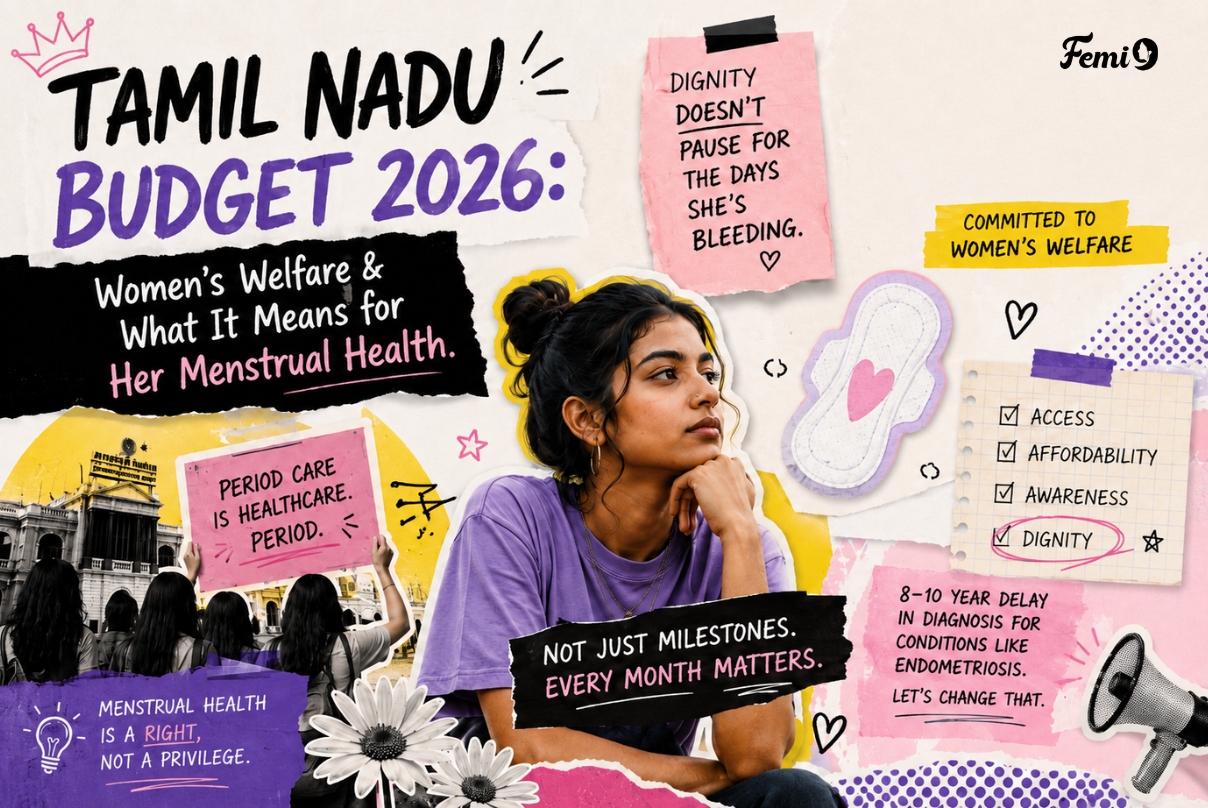
Tamil Nadu Budget 2026 Focuses on Women's Welfare — Here's What It Means for Her Menstrual Health
Tamil Nadu's first New Government Budget, presented this week, is generous with its milestones for women — the marriages, the births, the moments the whole family gathers around. But somewhere in the fine print, there's a question the Budget doesn't quite answer: what about the ordinary Tuesday? The cramp that doubles her over at her desk, the pad she can't afford to change as often as she should, the period pain she's been taught to simply carry. Sound familiar?
A Budget That Says It Sees Women
Tamil Nadu Finance Minister N Marie Wilson presented the state's maiden Budget under the state government, earmarking over ₹1,000 crore for schemes aimed directly at women, alongside a broader welfare allocation estimated between ₹15,000 and ₹18,000 crore for the year, as reported by Telangana Today. The headline commitments are built around milestone moments — marriage, childbirth, and support for widows and destitute women. The Finance Secretary framed these as investments in women's empowerment, not just one-time gifts — a signal that the state sees women's welfare as core public spending, not an afterthought.
The Gifts Are Generous. But What About the Everyday?
Weddings and births are once-in-a-lifetime lines in a Budget. Periods are not — they show up every month, for roughly 35 to 40 years of a woman's life, whether or not there's a scheme attached to them. Tamil Nadu was actually one of the earliest Indian states to recognise this gap in menstrual hygiene: its free sanitary napkin programme, running in dignity kits for adolescent girls, new mothers, and women in government institutions, has existed in some form for over a decade. It's a genuinely pioneering scheme on paper. In practice, though, coverage still leans heavily on school and hospital distribution — leaving working women, college students, gig and informal workers, and anyone simply not enrolled in the right institution to source sanitary pads in India that actually suit their flow or their skin. A government scheme can hand out a pad. It can't teach a girl what size she needs, or tell a woman that her period care isn't something to just tolerate — and the gap shows up just as much for sanitary pads Chennai office-goers rely on as it does for anyone in a rural taluk.
Why Menstrual Health Deserves a Line Item Too
This isn't a small gap. Every menstrual health India report tends to measure only access — how many pads reach how many girls — and rarely outcomes. Because period pain has been treated as routine for so long, women in India face an 8 to 10-year delay in getting properly diagnosed for conditions like endometriosis or adenomyosis, according to clinical research on dysmenorrhea in India. It shows up at work too — a 2025 systematic review on ScienceDirect found that heavy periods measurably reduce workplace productivity, and moderate to severe period pain drives higher absenteeism, costs that rarely appear on any state or company balance sheet. Even the courts have started to catch up: earlier this year, in Dr Jaya Thakur v. Government of India (2026), the Supreme Court recognised menstrual health and hygiene as part of the fundamental Right to Life and Dignity under Article 21, as reported by The News Minute. Tamil Nadu's own Budget, with its focus on women's dignity in marriage and motherhood, sits naturally alongside that idea — dignity doesn't pause for the days she's bleeding.
What Every Woman in Tamil Nadu Can Do, Budget or No Budget
Policy takes time. Your next period doesn't wait for it. Until menstrual wellness gets the same weight as milestone schemes, small, practical choices go a long way: switching from whatever sanitary pads Tamil Nadu households have used out of habit to heavy flow sanitary pads actually sized for your flow, choosing rash free sanitary pads made with chemical-free materials on the days your skin is most sensitive, and treating heavy bleeding or pain that won't ease as something worth a doctor's visit — not something to outlast. If you're not sure where you're going wrong, our guide to the best sanitary pads for heavy flow and how to pick the right pad size breaks down exactly where most women get their protection wrong — including the real difference in organic sanitary pads vs regular sanitary pads, the ones still sitting in most Tamil Nadu households.
Building Workplaces and Communities That Don't Wait for Legislation
Tamil Nadu's growing focus on its Gen Z workforce is also, whether the Budget says so or not, an investment in a generation of young women who will soon be commuting to offices, colleges, and factories every single day of the month. Employers and institutions across the state don't need to wait for the next Budget session to act. Stocking organic sanitary pads and chemical-free sanitary pads in washrooms, treating period pain as a legitimate reason for flexibility, and simply talking about menstrual health openly are low-cost steps with outsized impact.
The Bottom Line
Tamil Nadu's 2026 Budget tells women it sees their biggest days — the wedding, the birth, the moment they need a fresh start. That's worth acknowledging. But the days in between matter just as much, and no government scheme, however generous, replaces a woman knowing her own body and having the right products to care for it. If a state can find crores for a wedding gift, the least the rest of us can do is stop asking women to simply bear with the pain that comes every month in between. Explore Femi9's organic, rash-free sanitary pads for heavy flow — made for how Indian women actually bleed, in Tamil Nadu and everywhere else.