

Best Leakage-Proof Sanitary Pads: What Really Helps Prevent Period Leaks?
It's a feeling almost every woman knows by heart: that sudden, sinking dread when you stand up and wonder — did it leak? The quick, discreet check behind you. The jumper tied around the waist "just in case." The night you barely slept because you were terrified of staining the sheets. A single leak can unravel a whole day's confidence, and the worst part is how alone it can make you feel — as if everyone else has this figured out and you're the only one who doesn't.
Here's the truth: you don't. Leaks are common, they're rarely your fault, and "leakage-proof" pads aren't just marketing — when they're well-designed, they genuinely work. This guide explains why leaks really happen and what actually prevents them, so you can stop bracing yourself every time you stand up.
Why Pads Leak in the First Place
A leak isn't a sign you did something wrong — it's almost always a sign the pad wasn't matched to the moment. Leaks usually come down to four fixable things:
• It's the wrong size: a short or narrow pad can't cover where the flow actually goes — especially overnight, lying down, when it travels backward.
• The core absorbs too slowly: if liquid arrives faster than the pad can pull it in, it pools on the surface and escapes at the edges.
• There's no side barrier: without raised edges or leak-guards, a fast or heavy flow simply runs off the sides.
• It's left on too long: a saturated pad can't hold any more, no matter how good it is — full is full.
What Actually Makes a Pad "Leakage-Proof"
"Leakage-proof" isn't one feature — it's a few working together. Here's what genuinely holds leaks back:
1. The Right Size and Length
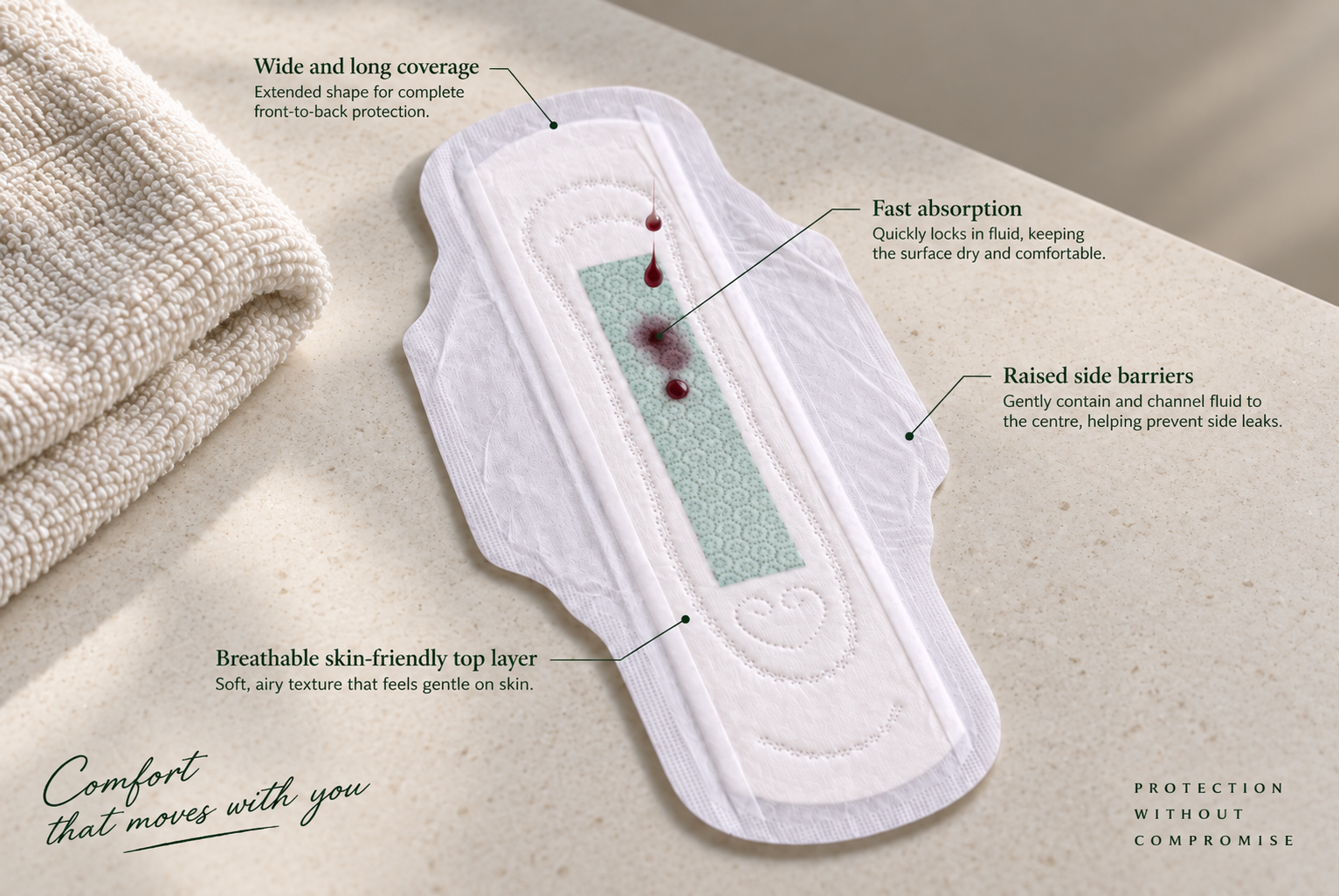
Coverage is everything. A longer, wider pad — L and XL for heavier flows — gives liquid somewhere to be absorbed before it reaches an edge. This is the single biggest factor, especially at night.
2. A Fast, Deep-Locking Core
A good core doesn't just hold liquid — it pulls it in quickly and locks it away from the surface, so the top layer stays dry and nothing pools. Speed matters as much as capacity, particularly on your heaviest days.
3. Leak-Guard Side Barriers
Raised edges or channels act like gentle walls, guiding flow into the core instead of letting it run off the sides. This is what genuinely earns a pad the word "leakage-proof" — and it's the feature cheap pads most often skip.
4. But Don't Sacrifice Your Skin
Here's the honest catch, because you deserve the truth and not a sales pitch: many "leak-proof" pads achieve it with thick plastic layers that trap heat and cause rashes — trading one problem for another. True protection shouldn't cost you your comfort. The best leakage-proof pads pair strong coverage with a breathable, skin-friendly top sheet, so you stay dry and rash-free. (We dig into that comfort-vs-coverage balance in our guide to the best sanitary pads for heavy flow.)
Simple Habits That Stop Leaks
• Change every 3–4 hours on heavier days — a fresh pad absorbs; a full one leaks.
• Size up for nights and position the pad slightly further back for lying down.
• Wear snug cotton underwear so the pad stays put and doesn't shift or bunch.
• Carry spares, so a long day never forces you to stretch one pad too far.
The Pad Designed to Keep You Dry
This is exactly what Femi9's organic cotton pads are built around. They combine the things that actually prevent leaks: L and XL sizes (270mm and 330mm) for real coverage, an absorbent core that pulls liquid away fast and locks it in, and leak-proof edges that guide flow into the core instead of off the sides. And crucially, they do it with a breathable organic cotton top sheet, made without harsh chemicals, fragrance, or chlorine — so you get leak protection without the rashes. That's genuine leakage-proofing that respects your skin. Browse sizes on the Femi9 products page, or read more on the Femi9 blog.
Frequently Asked Questions
What makes a sanitary pad leakage-proof?
A combination: enough length and width for coverage, a fast-absorbing core that locks liquid away, and raised leak-guard side barriers that stop flow running off the edges. No single feature does it alone — they work together.
How do I stop my pad from leaking at night?
Use a longer XL pad positioned slightly further back, change it right before bed, and wear snug cotton underwear to hold it in place. A fast-absorbing core matters more than sheer thickness.
Why do my pads keep leaking even when they're not full?
Usually it's a coverage or side-barrier issue — the flow is escaping at the edges before the core absorbs it, often because the pad is too short, too narrow, or has shifted out of position.
Are leakage-proof pads bad for sensitive skin?
They can be if they rely on thick plastic layers, which trap heat and cause rashes. Look for leak protection paired with a breathable cotton top sheet — you shouldn't have to choose between staying dry and staying comfortable.
You deserve to stand up without checking, and sleep without dread. The right leakage-proof pad — coverage, a fast core, side barriers, and a breathable top sheet — quietly gives you that everyday confidence back.
Related Reading on Femi9.in
• Best Sanitary Pads for Heavy Flow: How to Prevent Leaks Day and Night — sizing and absorbency for heavier flows.
• Best Sanitary Pads for Summer Heat: Staying Rash-Free with Heavy Flow — leak protection without the heat and rashes.
• Are Cotton Sanitary Pads Worth Switching To? — why a breathable top sheet matters, even on heavy days.
• Mental Load, Period Stress & Chemical-Free Sanitary Pads — how period-related stress and everyday mental load can influence comfort, planning, and menstrual care choices.
• Rash-Free Pads for Periods: Choosing Better Comfort for Sensitive Skin — what can contribute to pad-related irritation and what to look for when choosing comfortable period protection.
External References
• NHS — Heavy Periods: https://www.nhs.uk/conditions/heavy-periods/
• Mayo Clinic — Menorrhagia (Heavy Menstrual Bleeding): https://www.mayoclinic.org/diseases-conditions/menorrhagia/symptoms-causes/syc-20352829
• World Health Organization — Menstrual Health: https://www.who.int/health-topics/menstrual-health