

Rash-Free Pads for Periods: Because Day Two Shouldn’t Hurt
|
IN THIS ARTICLE |
|
|
01 / Why period rashes happen 02 / Soothing a rash you already have 03 / Why nights are the worst |
04 / What Femi9 pads are made of 05 / Preventing the next one 06 / Rash-free pad FAQs |
It usually starts on day two. A small warmth that turns into an itch you cannot scratch, then a raw line along the inner thigh that makes sitting down an event. By day four you are walking carefully and counting hours until you can get home. Almost every woman reading this knows that feeling, and almost every one has decided it is simply part of having a period. It is not. It is a reaction to a product, and reactions can be stopped.
01 / Why Period Rashes Happen
The skin around the vulva is thinner than skin elsewhere, lacks a protective outer keratin layer and absorbs far more readily — which is why research on vulvar contact dermatitis describes it as highly susceptible to contact allergens. Whatever sits against it for eight hours has a very direct route in. A survey on the adverse effects of sanitary pads found contact dermatitis among the most common problems women reported — itching, redness, swelling, soreness — traced to adhesives, synthetic fibres and added fragrance. Most of those women never saw a doctor.
Three culprits do nearly all the damage: a plastic top sheet that traps heat and moisture, friction from synthetic fibres, and chemical irritants, fragrance above all. Each is a design choice, which means each is avoidable.
02 / Soothing a Rash You Already Have
If you are uncomfortable right now, this is the sequence that helps most:
• Change more often, not less — every four hours while the skin is sore. Dampness keeps a rash going.
• Switch to an unscented cotton pad immediately — continuing with the pad that caused it will not let the skin settle.
• Clean with plain water only — scented washes, wipes and intimate hygiene products usually make irritated skin worse.
• Wear loose cotton underwear — tight or synthetic underwear adds the friction you are trying to remove.
See a doctor if the rash blisters, weeps, spreads, comes with unusual discharge or odour, or does not settle within a cycle of switching. The World Health Organization frames menstrual health as ordinary healthcare — not something to manage alone in silence.
03 / Why Nights Are the Worst
The rash is often worst in the morning, and there is a reason. Overnight you wear one pad for seven or eight hours without moving air, usually on a heavier flow. Heat builds, moisture sits, and friction happens every time you turn over. A short pad makes it worse, because you compensate by lying still and wearing it longer than you should.
A proper night pad fixes both. Femi9’s 330mm XL night pads give the length that stops back leakage, and the XL double-wing version holds position if you move a lot in your sleep.
04 / What Femi9 Pads Are Made Of
Worth knowing while you shop: a 2022 Toxics Link study tested ten Indian pad brands and found phthalates and VOCs in every sample, organic ones included. India has no regulation on chemical content, so "organic" on a wrapper is a claim, not a certification. By that standard, here is our material list — and remember the three culprits, because every layer below is built against one of them.
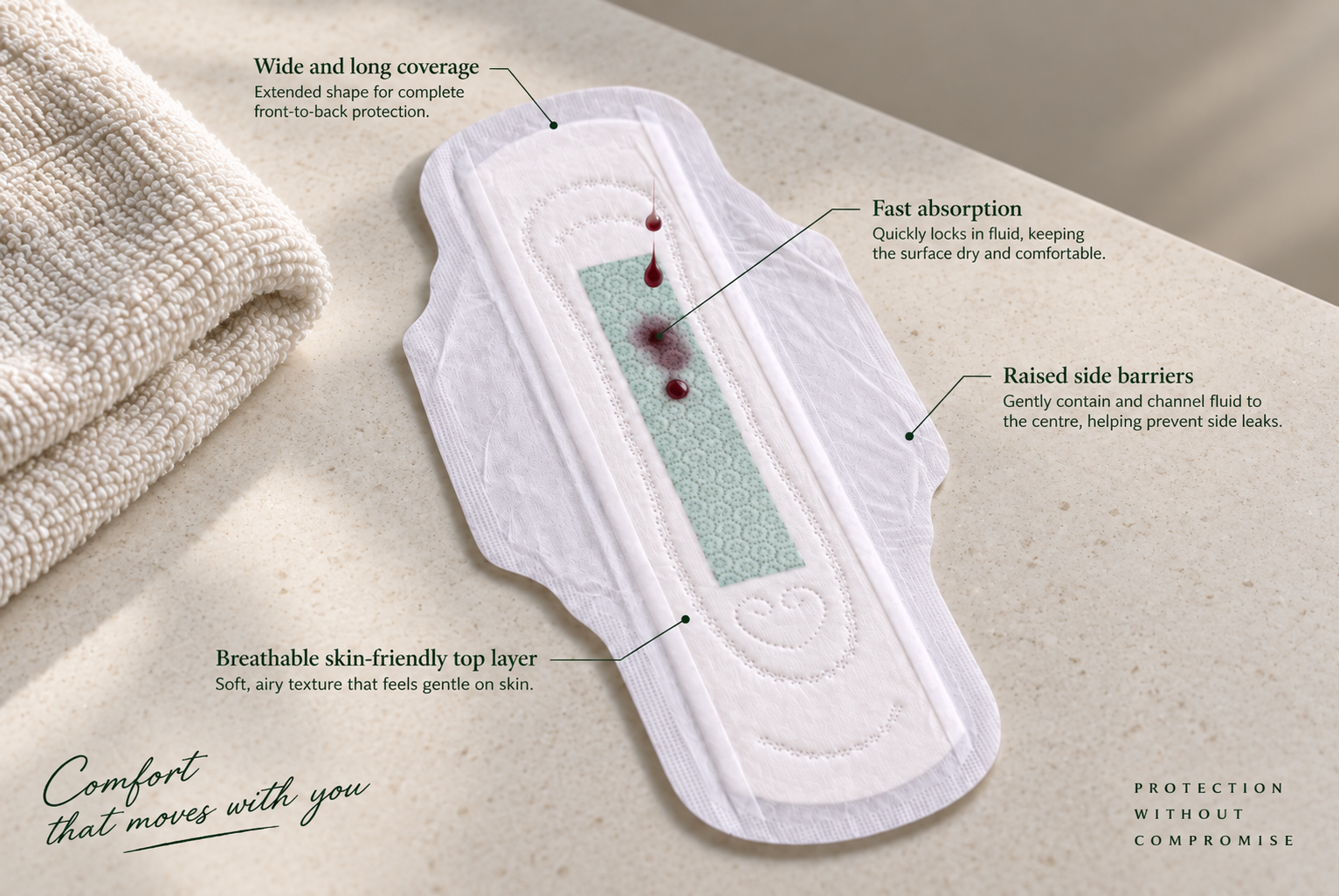
• Breathable cottony top layer — the layer against your skin for eight hours. Air moves through it, so heat and damp do not collect the way they do under plastic. This is the one that decides how day two feels.
• Pure surgical cotton layer — medical-grade cotton, the standard used where skin is already broken or sore. Soft enough that friction stops being a factor.
• 9 smart layers — wicking, spreading, locking and sealing, each doing one job. Fluid is pulled down and held there instead of sitting against you, which is what keeps the surface dry.
• 4X absorption — four times a standard pad. Dryness is not a comfort extra here; it is the single biggest factor in whether a rash forms at all.
• Leakage-free construction — a sealed core and wings that stay put on a bus, a scooter or through a night of turning over. No shifting means no rubbing.
• Rash-free and chemical-free — no chlorine bleaching, no dyes, no synthetic fragrance. These are the three additives most often behind contact dermatitis, and they are simply absent.
• Gentle enough for daily use — mild enough to wear on non-period days for discharge or spotting, which matters if your skin is still recovering.
• Fully biodegradable and eco-friendly — breaks down after disposal instead of sitting in landfill for centuries the way plastic-based pads do.
None of that is exotic. It is simply what a pad looks like when it is designed around skin rather than around a price point.
05 / Preventing the Next One
Prevention is dryness and fit. The NHS notes periods run two to seven days, heaviest in the first two — so use a bigger pad early and a lighter one later rather than one size throughout. Heavy days call for XL, regular days for 290mm Large, light days for 180mm minis; the 280mm bridges the gap. Testing a new pad? Try your heaviest day with a 3-pad pack first.
06 / Rash-Free Pad FAQs
Do cotton pads really prevent rashes?
They remove two of the three main causes — trapped heat and irritating additives. The third, dampness, depends on absorbency, so a pad that is both breathable and genuinely absorbent is what prevents rashes. Cotton alone is not a magic word.
How long does a pad rash take to heal?
Usually a few days once the irritant is removed and the skin is kept dry. If it persists after a full cycle on an unscented cotton pad, see a doctor rather than switching brands again.
Which pad is best for rashes and heavy flow at night?
A long, breathable, fragrance-free pad. The 330mm XL gives overnight length with a cotton top sheet, so you are not choosing between leak protection and comfort. Start with a 3-pad XL pack if you are unsure. Loose cotton underwear helps too — tight or synthetic underwear traps heat and compounds whatever the pad is doing.
Final Thought
You have probably never mentioned this to anyone. Most women do not — they change brands quietly and assume the discomfort is the cost of a period. It is not. Femi9 makes rash-free, chemical-free cotton sanitary pads — breathable, unscented and gentle enough to wear every day. Read the Femi9 blog, check our FAQ, learn what we stand for, or get in touch.
Comfort against your most sensitive skin is not a luxury. It is the minimum you should expect, every single day of your period.
References & Further Reading
• Contact Allergens in Feminine Hygiene Products and Vulvar Contact Dermatitis (PMC): https://pmc.ncbi.nlm.nih.gov/articles/PMC9699505/
• Cosmoderma — Adverse Effects of Sanitary Pads: A Cross-Sectional Survey: https://cosmoderma.org/a-descriptive-cross-sectional-questionnaire-based-survey-amongst-the-women-regarding-the-adverse-effects-of-sanitary-pads/
• Toxics Link (2022) — Wrapped in Secrecy: Toxic Chemicals in Menstrual Products: https://ruralindiaonline.org/en/library/resource/wrapped-in-secrecy-toxic-chemicals-in-menstrual-products/
• NHS — Periods: https://www.nhs.uk/conditions/periods/
• World Health Organization — Menstrual Health: https://www.who.int/health-topics/menstrual-health