

Period Myths in India: What Science Actually Says
She was twelve, and it was the seventh day. A bath, new clothes, and a visit to the family deity to "purify" herself — that was the ritual, and nobody explained why. Years later, in college, she still flinched a little walking past the kitchen on day one of her period, even though she couldn't say what she thought would actually happen if she didn't.
If some version of this sounds familiar, you're far from alone. Period myths in India aren't fringe beliefs — they're woven into daily life for millions of women, often passed down with love, rarely questioned out loud. This guide isn't here to mock anyone's upbringing. It's here to do something more useful: hold the most common period myths up against what medical research and global health bodies actually say, so you can decide for yourself what to carry forward and what to quietly let go.
Why These Myths Still Shape Daily Life
This isn't a fringe issue. According to India's National Family Health Survey (NFHS-5, 2019–21), only about 77.3 per cent of women aged 15–24 reported using hygienic methods of menstrual protection — and that figure drops as low as 32 per cent in some states, shaped heavily by stigma, access, and what's considered "acceptable" to even discuss. A peer-reviewed field study in Odisha documented girls being confined at home for seven days after their first period, forbidden from touching anyone in the household — practices rooted in the idea that menstruation is "pollution" to be cleansed, not a normal bodily process.
These beliefs don't just create discomfort — a systematic review of menstrual practices among tribal communities in India found widespread restrictions on food, water access, and religious participation tied to menstruation. Understanding which of these beliefs hold up medically, and which don't, is genuinely useful information — not just an academic exercise.
The Myths, Checked Against the Evidence
Myth 1: Periods Make You "Impure," So You Shouldn't Enter a Temple or Kitchen
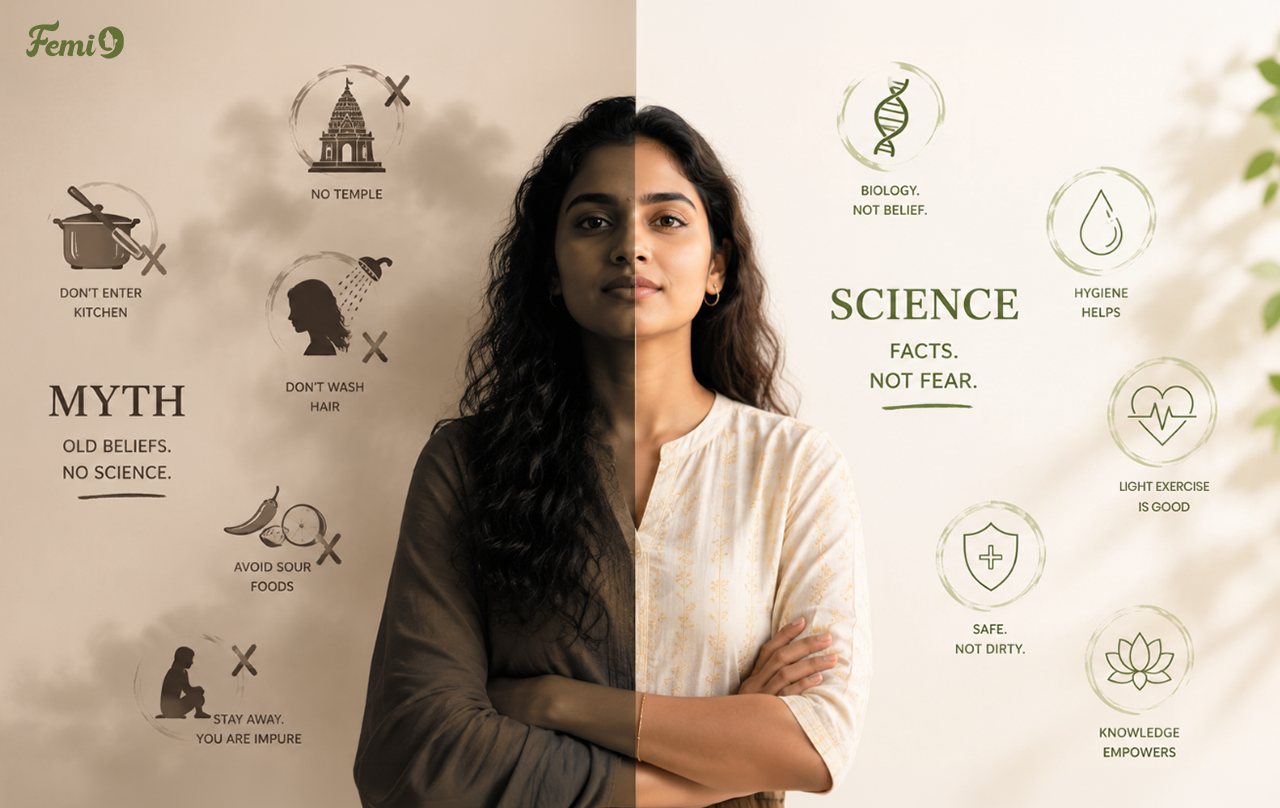
This is likely India's most widespread period myth, rooted in centuries-old ideas of ritual purity rather than biology. There is no medical or scientific basis for treating a menstruating person as unclean or contagious. Menstrual blood is not toxic, does not "spoil" food, and poses no health risk to anyone around you. The World Health Organization frames menstrual health as a normal, healthy part of the reproductive cycle — not a condition requiring isolation. This particular belief is cultural and religious in origin, and it's worth recognising that as different from a health-based restriction.
Myth 2: You Shouldn't Wash Your Hair or Bathe During Your Period
Some households still discourage hair-washing or bathing during menstruation, based on the idea it could "stop the flow" or cause illness. There's no physiological mechanism by which washing your hair affects your uterus. If anything, regular bathing during your period is more important, not less — it supports basic hygiene and can genuinely help you feel more comfortable during a physically taxing few days.
Myth 3: Certain Foods Must Be Avoided During Periods
Sour foods, curd, cold drinks — many Indian households have a list of things you're told to skip "during those days." There's no credible clinical evidence that any specific food group worsens menstrual bleeding or cramps. What genuinely helps with period discomfort is broader: staying hydrated, eating balanced meals, and, per multiple clinical reviews, getting light physical activity. If a particular food consistently seems to affect how you feel, that's worth noting for yourself — but it isn't a universal rule backed by research.
Myth 4: Exercise Is Unsafe During Your Period
This one keeps many young women out of sports and PE classes across Indian schools. The evidence says the opposite: moderate exercise during menstruation is not only safe for most people, it's been shown to help with cramps, mood, and fatigue by increasing blood flow and releasing endorphins. The NHS notes that staying active during your period is generally encouraged unless a specific medical condition says otherwise — there's no blanket reason to sit out.
Myth 5: Using a Tampon or Menstrual Cup Affects Virginity
This myth causes real anxiety, even though Femi9 doesn't sell either product — it's worth addressing because so many young women are told this as fact. Virginity is not a medical or biological state defined by the hymen; it's a social concept tied to sexual activity, not product use. The hymen itself is a thin, flexible tissue that can stretch from many non-sexual activities — including exercise — and its condition has no reliable connection to sexual history. Multiple clinical sources confirm internal period products do not "take away" virginity in any physical sense.
Myth 6: Period Blood Is "Dirty" or Toxic
Period blood is a combination of blood, uterine lining tissue, and vaginal secretions — biologically, it's not fundamentally different from other bodily fluids, and it isn't toxic to you or anyone else. The perception that it's unclean is a cultural framing, not a medical one, and it's one of the root beliefs behind many other restrictions on this list.
Myth 7: You Can't Get Pregnant If You Have Sex During Your Period
This is a genuinely risky myth to believe. While the odds are lower than mid-cycle, sperm can survive inside the reproductive tract for several days, and people with shorter or irregular cycles can ovulate soon after their period ends. Pregnancy during or right after menstruation is uncommon but not impossible — this isn't a reliable form of contraception.
Myth 8: PMS Is "Just in Your Head"
Premenstrual syndrome is a recognised, hormonally-driven set of physical and emotional symptoms — not an exaggeration or an excuse. It's caused by the drop in estrogen and progesterone before menstruation begins, and for some people it's severe enough to interfere with daily life (a more intense version is clinically known as PMDD). Dismissing PMS as "overreacting" isn't just unkind, it's medically inaccurate.
Why These Myths Persist — and Why That's Worth Understanding
Most of these beliefs weren't invented to hurt anyone. They were often passed down as protective wisdom, generations before anyone had reliable medical information to check them against. Recognising that context matters: the goal isn't to blame the people who taught you these things, but to gently update what gets passed down next.
• They travel through trusted relationships. Mothers, grandmothers, and aunts pass these down with care, which makes them feel more credible than they are.
• Periods still aren't openly discussed. When there's no space to ask "but why?", myths go unchallenged for generations.
• Some myths mix in a grain of practical truth. Old hygiene practices born from limited access to clean water or products sometimes hardened into rules that outlived their original reason.
• Shame keeps people from fact-checking out loud. It can feel easier to quietly follow a rule than to ask a doctor or search for it, especially as a teenager.
Common Mistakes to Avoid
• Assuming "tradition" and "medical fact" are the same thing. They can coexist respectfully, but they answer different questions.
• Dismissing family members who still follow these practices. Understanding beats confrontation — share information, don't demand change.
• Ignoring genuinely concerning symptoms because "periods are just like this." Severe pain, extremely heavy bleeding, or cycles under 21 or over 35 days deserve a doctor's opinion, not a shrug.
• Getting health information from unverified social media claims. "Detox" periods, seed cycling cures, and other trending claims are not backed by clinical evidence — when in doubt, check what WHO, NHS, or a gynaecologist actually says.
Frequently Asked Questions
1. Is it true that periods make you impure?
No — this is a cultural and religious belief, not a medical one. There's no scientific basis for treating menstruation as a state of impurity or contamination.
2. Can you exercise during your period?
Yes, for most people moderate exercise is safe and can actually reduce cramps, improve mood, and ease fatigue. Only stop or scale back if a specific medical condition or symptom tells you to.
3. Do tampons or menstrual cups affect virginity?
No. Virginity is defined by sexual activity, not by the condition of the hymen, which can stretch from many non-sexual activities. Internal period products don't change anyone's virginity status.
4. Is period blood dirty or toxic?
No. It's a mix of blood, uterine tissue, and vaginal secretions — not fundamentally different from other bodily fluids, and not harmful to touch or be near.
5. Can you get pregnant while on your period?
It's less likely than mid-cycle, but it is possible, especially with shorter or irregular cycles. It isn't a reliable way to avoid pregnancy.
Final Thoughts: Question Kindly, Choose Knowingly
You don't have to reject every tradition you grew up with to make room for facts — but you deserve to know which of these "rules" are medical and which are cultural, so the choice is actually yours. Most period myths in India come from a place of care, even when the science doesn't hold up. Passing on accurate information is its own kind of care too.
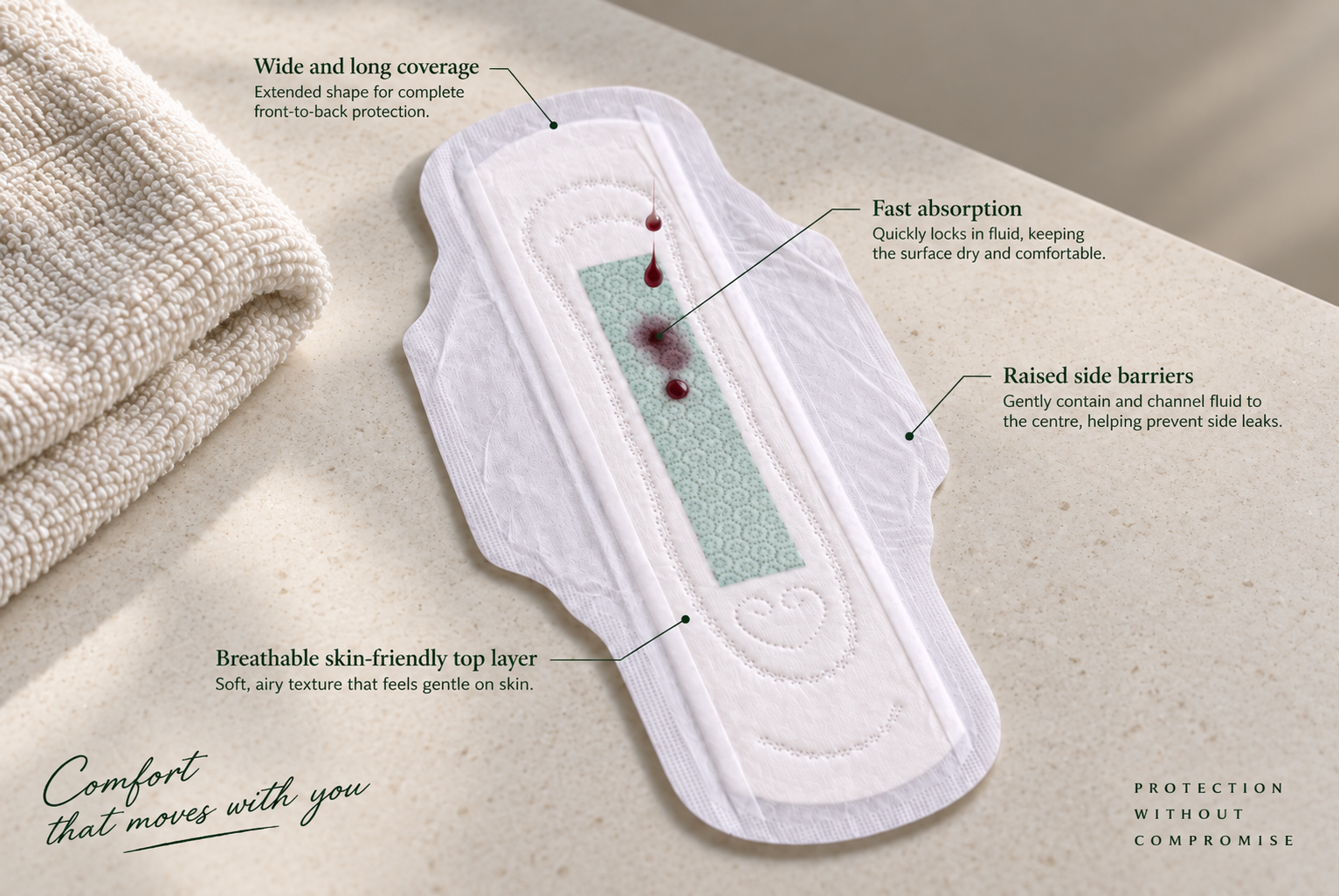
One thing that's entirely true, myth or not: comfort matters on your period, especially on the days your flow is heavier or less predictable than usual. Femi9's organic cotton pads are made with a breathable organic cotton top sheet and an absorbent core layer infused with aloe vera and corn extracts, designed for comfort without needing to believe anything mystical about it. You can read more about the brand's approach on the Femi9 blog.
Periods are not a punishment, a pollution, or a secret. They're biology — and biology deserves facts, not folklore.
References (linked contextually within the article)
• World Health Organization — Menstrual Health: https://www.who.int/health-topics/menstrual-health
• NHS — Periods: https://www.nhs.uk/conditions/periods/
• PMC — National Family Health Survey (NFHS-5) Spatial Analysis of Menstrual Hygiene in India: https://pmc.ncbi.nlm.nih.gov/articles/PMC10629021/
• PMC — Menstrual Health and Hygiene Practices Study, Odisha, India: https://pmc.ncbi.nlm.nih.gov/articles/PMC10898167/
• PMC — Menstrual Hygiene Practices in Indian Tribal Females: Systematic Review: https://pmc.ncbi.nlm.nih.gov/articles/PMC10439841/