

Body Image and Social Media: What It’s Doing to Young Women in India
She was fourteen the first time she deleted a photo of herself. Not because anything was wrong with it
— she just held it next to a reel she had watched forty times that week, and something in her chest quietly folded. By sixteen she had a rule: no photos from the left, no photos without a filter, no photos on the days her stomach felt bloated. Nobody taught her that rule. She learned it from a screen, one scroll at a time.
If you have ever stood in front of a mirror trying to become the version of yourself that the internet seems to prefer, please hear this first: you are not vain, you are not weak, and you are not the only one. Millions of young women in India are doing exactly the same thing tonight. This guide is not here to tell you to log off and love yourself. It is here to explain, honestly, what social media is doing to how you see your own body — and to offer a few small, doable things that actually help.
This Isn’t “Just Being Sensitive” — The Numbers Are Real
Body image struggles among Indian adolescents are far more common than most families realise. A 2025 cross-sectional study of 740 school students published in Cureus found that nearly 29.5 per cent screened positive for body dysmorphic concerns — and among girls, that figure rose to 33.1 per cent, compared with 26.2 per cent of boys. The same study found that students who spent more than four hours a day on image-based platforms, and those who habitually used beauty filters, scored significantly higher on dysmorphic concern than those who did not.
Qualitative research tells the same story in a softer voice. A study of adolescent girls in Delhi published in the International Journal of Indian Psychology found that most participants held a negative perception of their own bodies, shaped largely by comparing themselves with celebrities and peers online — and described a sharp gap between the encouragement they received in comments and the body shaming they experienced in real life.
This sits inside a bigger picture. The World Health Organization reports that roughly one in seven adolescents aged 10–19 worldwide lives with a mental health condition, and that most cases go undetected and untreated. Body image is not a vanity issue. It is a health issue.
Why Social Media Hits Body Image So Hard
It Turned Comparison Into a Full-Time Job
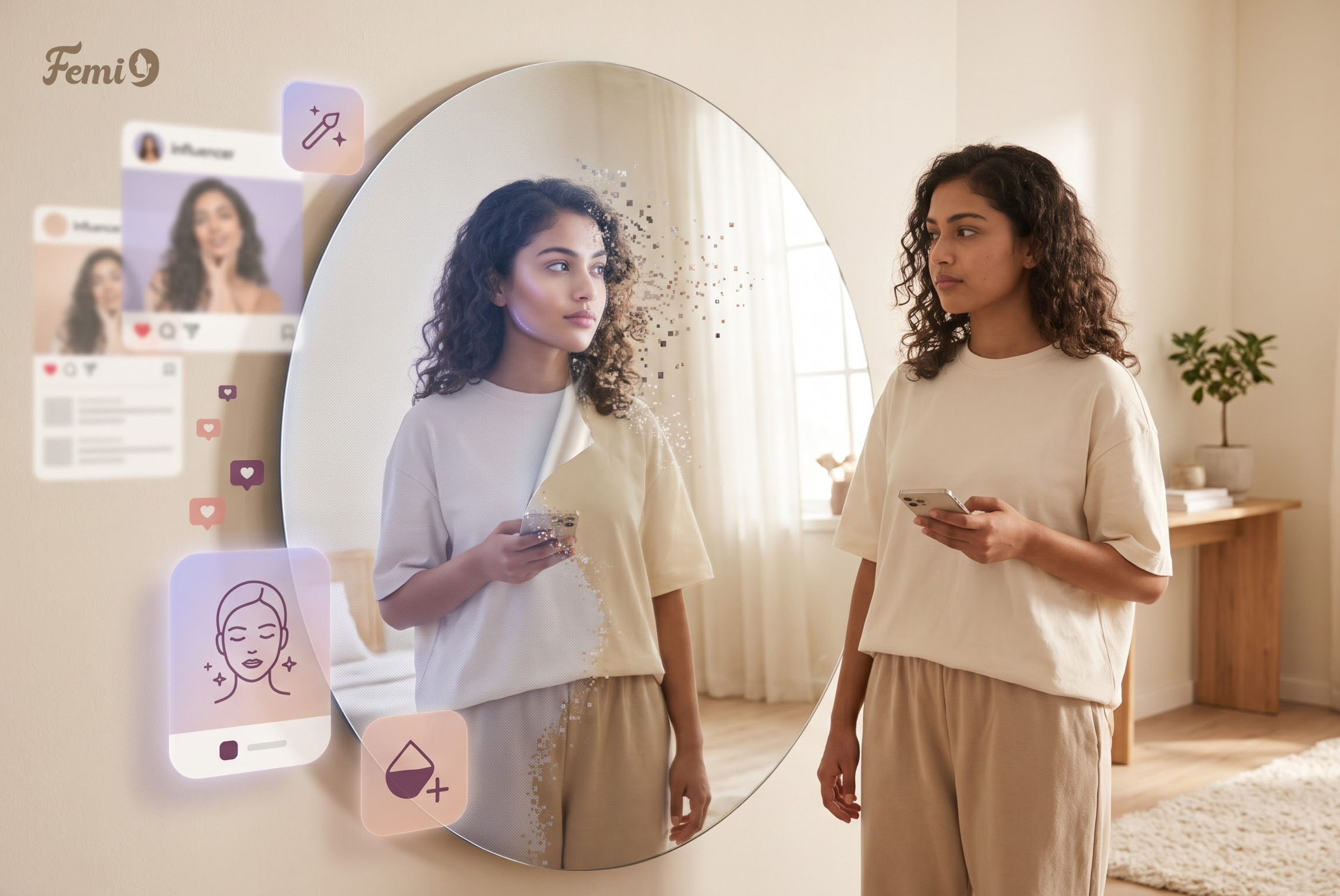
Comparing ourselves to others is ancient and human. What changed is the sample size. Your grandmother compared herself to perhaps thirty women in her lifetime. You compare yourself to hundreds before lunch — and almost every one of them has been lit, angled, edited and selected from fifty attempts. You are measuring your unedited Tuesday morning against someone else’s best frame of the year.
Filters Quietly Moved the Finish Line
Beauty filters can smooth skin, slim a jaw, enlarge eyes and reshape a nose in real time. The danger is not that they exist — it is that they train your eye. After enough exposure, the filtered face becomes the reference point and your own face starts to look like the mistake. Researchers have described young people seeking cosmetic procedures to resemble their own filtered photographs, a pattern nicknamed “Snapchat dysmorphia.” A King’s College London study of 16–18-year-olds similarly found that image-based social media use, and using it specifically for appearance-related reasons, is linked to stronger body dysmorphic symptoms.
The Algorithm Learns What Makes You Insecure
Recommendation systems reward attention, not wellbeing. If you pause on a “glow-up” reel, a body-transformation clip or a skin-lightening advertisement, the feed reads that pause as interest and sends you more. Insecurity is sticky, and sticky content performs well. What feels like your own obsession is often a loop that was built and reinforced around you.
It Arrives Exactly When Your Body Is Changing Most
For most Indian girls, heavy social media use begins around the same years as puberty and the first period. Hips widen, skin breaks out, weight shifts, cramps arrive — all completely normal, all happening in a body that is suddenly being judged against a filtered feed. Add the silence that still surrounds menstruation in many homes, and a girl can conclude that her changing body is something to hide. It isn’t. You can read more about that silence in our guide to period myths and menstrual health on the Femi9 blog.
How to Protect Your Body Image Without Deleting Every App
You do not have to quit the internet. You do have to change your relationship with it. These steps are small on purpose — small is what people actually keep doing.
1. Curate Ruthlessly, Not Guiltily
For one week, notice how you feel after each account. If a profile reliably leaves you feeling worse about your own body, mute or unfollow it. You are not being rude or jealous. You are deciding what gets to speak to you every day, which is an entirely reasonable thing to control.
2. Name the Comparison Out Loud
When the feeling comes, try saying it plainly in your head: “I am comparing myself to an edited photo right now.” Naming a thought creates a small gap between you and it. In that gap, you get to choose your next move instead of sliding straight into self-criticism.
3. Protect the First and Last Ten Minutes of Your Day
Scrolling before you are fully awake or just before sleep tends to land hardest, because your defences are lowest. Keeping those two windows screen-free is one of the highest-impact changes most people report — and it costs nothing.
4. Say It to a Real Person
Body image shame grows in private. Telling one trusted person — a friend, a sister, a cousin, a teacher — that you have been feeling this way almost always shrinks it. You will usually discover they have felt it too, which is both sad and enormously relieving.
5. Shift From How Your Body Looks to What It Does
You do not have to leap to loving your body. Body neutrality is an easier first step: your body carried you up the stairs, laughed with your friends, sat through an exam, got through a painful period day.
That is a body doing its job, not a body auditioning.
6. Make Your Hardest Days Physically Easier
Confidence is harder to hold on to when you are physically uncomfortable, and period days are often when self-criticism peaks. Practical comfort genuinely helps: breathable clothing, warmth for cramps, and period protection that does not itch, chafe or make you feel like you are managing a leak all day. Femi9’s organic cotton sanitary pads are made with a breathable organic cotton top sheet and a core infused with aloe vera and corn extracts, designed to stay rash-free on sensitive skin — with a lighter 180mm option for lighter days and XL 330mm pads for heavy flow and overnight protection.
7. Know the Line Between a Bad Day and Something More
Most of us dislike our reflection sometimes. It becomes a health concern when appearance worries take over hours of your day, when you avoid school, work or friends because of how you look, or when your eating or exercise habits start feeling like rules you cannot break. The NHS guidance on body dysmorphic disorder explains these signs clearly and gently. If any of it sounds like you, that is worth telling a doctor or counsellor — not because something is wrong with you, but because help exists and it works.
Common Mistakes to Avoid
• Treating a filtered image as a target. Filtered faces are not achievable in real life, because they are not real faces. Chasing one is a race with no finish line.
• Assuming the comments are the truth. Kind comments online and cruel remarks offline can come from the same people. Neither one is a reliable measure of your worth.
• Taking health advice from a viral video. Trending “detox” routines, extreme regimens and quick-fix promises are rarely evidence-based and can do real harm. Check with a doctor before acting on anything you saw in a reel.
• Waiting until it feels “serious enough” to ask for help. You do not need a diagnosis to deserve support. Earlier conversations are easier conversations.
• Body shaming yourself as a joke. Self-deprecating humour about your own body still rehearses the belief underneath it, and other people learn to repeat it back to you.
If You’re a Mother, Teacher or Elder Sister Reading This
You may be watching a girl in your life shrink in front of a screen, and feeling powerless. A few things that consistently help: comment on what she does rather than how she looks; avoid criticising your own body out loud in front of her, because she is learning the script from you; and ask curious questions instead of confiscating the phone, which usually ends the conversation rather than the problem.
And when it comes to periods, normalising is everything. A girl who is told her cycle is ordinary, manageable and nothing to hide grows up with a very different relationship to her body than one who learns to whisper about it. Choosing comfortable, skin-friendly products is a small part of that message — you can read about our approach on the About Femi9 page, or start with the 3-pad organic trial pack if she is trying organic cotton pads for the first time.
Frequently Asked Questions
Does social media actually cause body image issues?
Research consistently shows a strong association rather than a simple single cause. Heavy use of image-based platforms, frequent filter use and appearance-driven scrolling are all linked to higher body dissatisfaction — but genetics, family attitudes, peer comments and bullying all play a part too. Social media is best understood as a powerful amplifier.
How does social media affect young women differently from young men?
Indian and international studies repeatedly find higher rates of body dissatisfaction and dysmorphic concern among girls and young women, and their concerns tend to cluster around weight, skin tone, body hair and facial features. Boys are affected too, more often around height and muscularity, but the intensity and volume of appearance-based content aimed at women is significantly higher.
How can I stop comparing my body to others on Instagram?
Start with your feed rather than your willpower. Mute or unfollow accounts that reliably make you feel worse, follow a wider range of real bodies, keep the first and last ten minutes of your day screen-free, and practise naming the comparison when it happens. Willpower alone rarely beats an algorithm; changing the inputs does.
At what age do body image issues usually start in India?
They commonly appear in early adolescence, around the same time as puberty and the first period, and research suggests concerns tend to intensify through the later teen years. This is precisely why early, open conversations at home and in school matter so much.
When should someone see a doctor about body image?
When appearance worries occupy hours of the day, cause avoidance of school, work or social life, or when eating and exercise start to feel like rigid rules. In India, Tele-MANAS, the Government of India’s free 24×7 mental health helpline, can be reached on 14416 in English and 20 regional languages. Speaking to a GP, school counsellor or psychologist is also a completely reasonable first step.
Final Thoughts: Your Body Is Not a Draft
The internet will keep suggesting that you are a work in progress — one routine, one product, one filter away from acceptable. It is a very profitable idea and a very old lie. Your body is not a rough draft awaiting edits. It is the only one you get, and it has been quietly carrying you through every single day you have ever had.
Some days that will feel obvious, and some days it won’t. On the harder days, small comforts matter more than big resolutions — which is a large part of why we make what we make. Femi9’s chemical-free, rash-free organic cotton pads exist so that at least one thing about your week is not working against you. You can find more honest, judgement-free period guidance on the Femi9 blog, or check our FAQ page for practical answers.
You were never the thing that needed fixing. The mirror the internet handed you was.
A gentle note: if reading this brought up something heavy, please talk to someone you trust, or call Tele-MANAS on 14416 (free, 24×7, all over India). You deserve support, not silence.
References (linked contextually within the article)
• Cureus (2025) — Role of Social Media in the Rising Body Dissatisfaction and Dysmorphia Among Adolescents: pmc.ncbi.nlm.nih.gov/articles/PMC11873132
• International Journal of Indian Psychology (2024) — Exploring the Influence of Social Media on Body Image: A Study on Adolescent Girls: ijip.in/articles/social-media-on-the-body-image
•  Frontiers in Psychology (2023), King’s College London — The Association Between Social Media Use and Body Dysmorphic Symptoms in Young People: pmc.ncbi.nlm.nih.gov/articles/PMC10471190
•  NHS — Body Dysmorphic Disorder (BDD): nhs.uk/mental-health/conditions/body-dysmorphia
• World Health Organization — Mental Health of Adolescents: who.int/news-room/fact-sheets/detail/adolescent-mental-health
• Tele-MANAS, Ministry of Health & Family Welfare, Government of India (Helpline 14416): telemanas.mohfw.gov.in