


Your Period Is Late Again: 8 Real Reasons Why — and When to See a Doctor
You have checked the calendar four times today. You have counted backwards on your fingers, twice, hoping you got the maths wrong. It is day thirty-eight and there is nothing — no cramps, no spotting, just that low hum of worry sitting behind everything else you are supposed to be doing.
If that is where you are right now, take one breath before you read on. A late period is one of the most common things a woman will experience in her life, and pregnancy is only one item on a fairly long list of explanations. Most of the reasons on that list are ordinary, temporary, and entirely fixable.
This guide walks through eight genuine causes of irregular periods, what actually counts as normal, and the specific signs that mean it is time to stop guessing and see a doctor. No lecturing, no scare tactics — just the information nobody sat you down and explained.
First: What Counts as a “Normal” Cycle?
Before you decide something is wrong, it helps to know where the goalposts actually are. According to the NHS, the average menstrual cycle is around 28 days — but anything from 21 to 35 days is considered normal, and a cycle that varies by a few days each month is not irregular at all. Cleveland Clinic defines irregular periods as cycles shorter than 21 days or longer than 35 days, missing three or more periods in a row, or flow that becomes markedly heavier or lighter than usual for you.
So a period that is three or four days late is, medically speaking, unremarkable. A cycle that is 33 days when your friend’s is 27 is not a problem — it is just your body. The word that matters most here is your. There is no universal number you are failing to hit.
One practical thing before we go further: start writing it down. Note the first day of bleeding each month, either in a diary or a period-tracking app. Two or three months of records will tell you and your doctor more than any amount of worrying at 1 a.m. The NHS specifically recommends using an app or diary to work out whether your periods really are irregular — because memory is unreliable and anxiety exaggerates.
8 Real Reasons Your Period Is Late
1. Pregnancy — Rule It Out First, Then Move On
It has to be first on the list, and it is the quickest to settle. A home pregnancy test taken from the first day of a missed period is highly accurate. If it is negative and your period still has not arrived a week later, test once more — then genuinely set the question aside and look at everything below. Many women spend weeks stuck on this one possibility while the real cause goes unexamined.
2. Stress — The Most Underestimated Cause of All
Your reproductive system is not separate from the rest of you. Sustained stress raises cortisol, which interferes with the hypothalamus — the part of your brain that signals when to ovulate. No ovulation signal, no period on schedule. In its most pronounced form this is a recognised clinical condition: the Endocrine Society’s clinical practice guideline on functional hypothalamic amenorrhoea describes chronic anovulation caused by psychological stress, weight loss, excessive exercise, or a combination of the three. A clinical review notes it accounts for a substantial share of secondary amenorrhoea cases — periods that stop after previously being regular.
Exam season. A job you are dreading. A bereavement. A wedding — yes, even happy stress counts. If your period went missing during a difficult stretch, that is not a coincidence and it is not you being “weak-minded.” It is your body sensibly deciding this is not the month.
3. PCOS or PCOD — The Most Common Medical Cause in India
Polycystic ovary syndrome is the leading medical reason behind irregular periods in Indian women, and it is significantly under-diagnosed. A nationwide cross-sectional study of 9,824 women aged 18 to 40, published in JAMA Network Open, found a weighted national prevalence of 7.2 per cent by NIH criteria and 19.6 per cent by the broader Rotterdam criteria. Among women with PCOS in that study, 43.2 per cent had obesity and 24.9 per cent had metabolic syndrome — which is why PCOS is a whole-body condition, not simply a period problem.
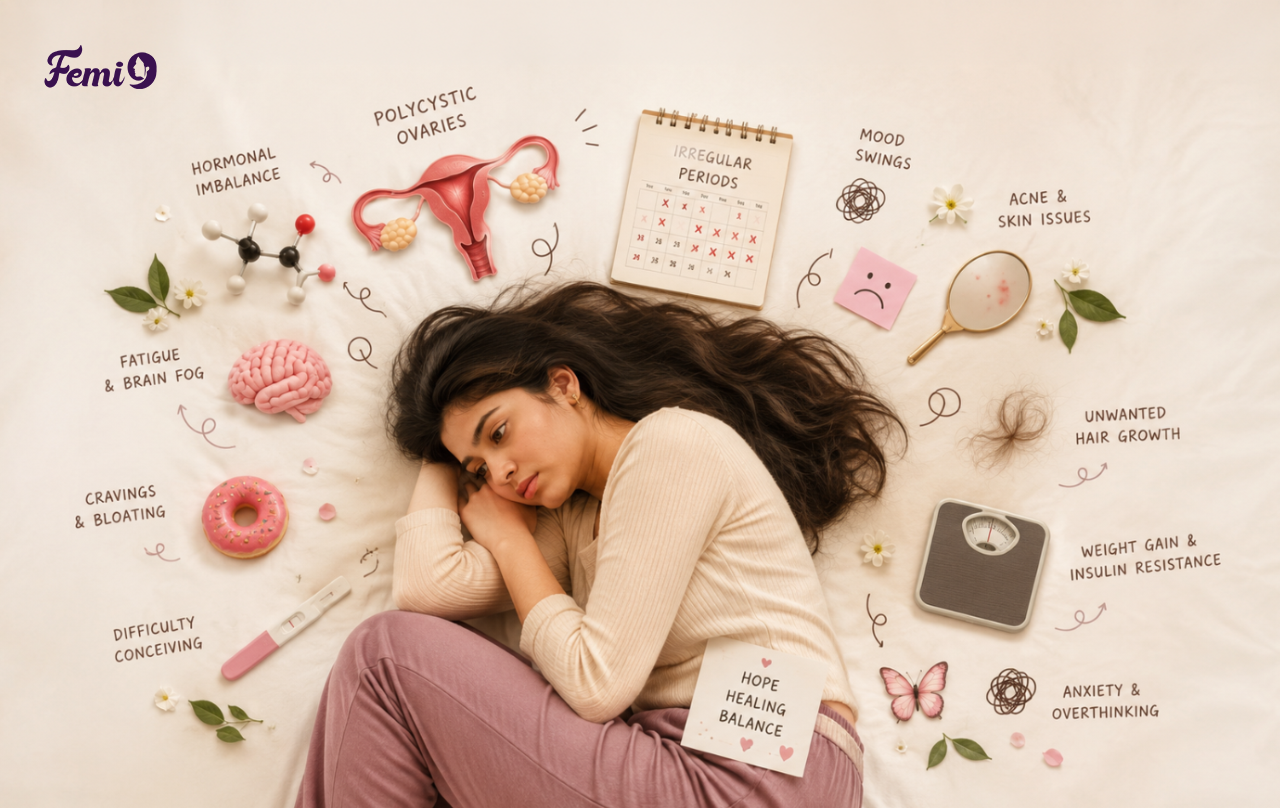
The pattern to watch for: cycles that stretch well past 35 days or vanish for months, alongside acne along the jawline, unwanted facial or body hair, hair thinning at the crown, weight that will not shift, or dark velvety patches of skin at the neck or underarms. If two or more of those sound familiar, this is worth investigating properly — not managing alone with home remedies from a reel.
It is also worth knowing that PCOS carries a real emotional weight. Research on quality of life among Indian women with PCOS found the psychological domain was the most affected of all, with a significant proportion reporting poor wellbeing. If you have been told to “just lose weight” and left it there, you deserved a fuller conversation than that.
4. Thyroid Problems — A Small Gland With a Big Say
Your thyroid regulates metabolism, and it has a direct influence on the menstrual cycle. Both an underactive and an overactive thyroid can throw off cycle length and flow. A cross-sectional study at a tertiary care centre in Delhi found that among women presenting with menstrual disorders, 44 per cent had some form of thyroid dysfunction — subclinical hypothyroidism in 20 per cent, overt hypothyroidism in 14 per cent, and overt hyperthyroidism in 8 per cent.
The encouraging part: this is one of the simplest causes to identify. A basic TSH blood test, widely available and inexpensive across India, will usually reveal it — and treatment is generally straightforward. If your late periods come with unexplained tiredness, feeling cold, hair fall, dry skin or unexplained weight change, ask specifically for a thyroid test.
5. Sudden Weight Change or Very Low Body Fat
Ovulation requires energy. When the body senses a shortage — rapid weight loss, severe dieting, an intense new fitness regime, or simply eating far less than you burn — it deprioritises reproduction. This is not a malfunction; it is efficient biology. Significant weight gain can disrupt cycles too, because fat tissue produces oestrogen and shifts the hormonal balance.
If your periods stopped when your diet or training changed, that is a signal worth listening to rather than pushing through. Missing periods for months is associated with bone loss over time, which makes this a genuine health matter and not a cosmetic one.
6. Contraception and Medication
Hormonal contraceptives — the progestogen-only pill, the injection, the hormonal IUS, and the implant — commonly cause lighter, irregular or entirely absent periods, and that is expected rather than alarming. Cycles can also stay unsettled for a few months after stopping the pill while your own rhythm re-establishes itself. Emergency contraception can shift the timing of your next period by a week or more in either direction. Some antidepressants, epilepsy medicines and steroids affect cycles as well; if you started something new and your period changed soon after, mention it to your doctor rather than assuming the two are unrelated.
7. Perimenopause — Often Earlier Than Women Expect
The transition towards menopause typically begins in the forties, though for some women it starts in the late thirties. Cycles become unpredictable — closer together, then further apart, heavier one month and barely there the next. Hot flushes, night sweats, disturbed sleep and mood changes often arrive alongside. This phase can last several years, and irregular periods are its defining feature, not a sign that something has gone wrong.
8. Illness, Travel, Sleep Disruption and Anaemia
A bout of fever, a viral illness, a sudden change of time zone, or weeks of broken sleep can each delay ovulation and push a period back. These delays are usually one-off and self-correcting. Anaemia deserves particular mention in the Indian context: analysis of National Family Health Survey (NFHS-5) data recorded anaemia in 57 per cent of women of reproductive age nationally, up from 53 per cent in the previous round. Heavy periods worsen anaemia, and severe anaemia can in turn disturb cycles — a loop that is easy to miss and very treatable once identified.
When to Actually See a Doctor
This is the part most articles leave vague, so here it is plainly. Book an appointment if any of the following apply to you:
• You have missed three or more periods in a row and pregnancy has been ruled out.
• Your cycle is consistently shorter than 21 days or longer than 35 days.
• Your periods were regular and suddenly became irregular, particularly if you are under 45.
• You are bleeding between periods, after sex, or after menopause.
• Bleeding is very heavy — soaking through a pad every hour or two, passing clots larger than a rupee coin, or bleeding for more than seven days.
• You have severe pain that stops you working, studying or sleeping.
• Irregular cycles come with acne, excess hair growth, hair loss or unexplained weight change — a possible PCOS picture.
• You have been trying to conceive for a year without success (six months if you are over 35).
You do not need to have all of these. One is enough to justify an appointment, and you are not wasting anyone’s time by asking. Bring your tracked dates with you — it makes the consultation dramatically more useful.
Common Mistakes to Avoid
• Assuming a late period always means pregnancy. Test once, confirm, and then look at the other seven causes rather than staying stuck on the first.
• Taking pills or tonics to “bring on” a period. Unprescribed hormonal medicines can worsen the underlying problem and mask the very symptoms a doctor needs to see.
• Waiting years before asking. PCOS and thyroid disorders respond far better to early management. Many Indian women wait until they are trying to conceive before anyone investigates — which is often a decade too late.
• Treating irregular cycles as a purely cosmetic or fertility issue. Long-term irregularity is linked to metabolic and bone health, whether or not you ever want children.
• Relying on social media for a diagnosis. Seed cycling, detox teas and “hormone-balancing” supplements are not backed by clinical evidence. A blood test costs less than three months of the powders.
• Being unprepared because you cannot predict the date. Irregular cycles mean surprise starts — keeping pads in your bag, desk and travel kit removes an entire category of stress.
Living With an Unpredictable Cycle in the Meantime
While you are figuring out the cause — and that can take a few months — there is a smaller, practical problem to solve: you cannot plan for a period you cannot predict. That means white kurtas become risky, long journeys become fraught, and you find yourself doing quiet arithmetic before every meeting.
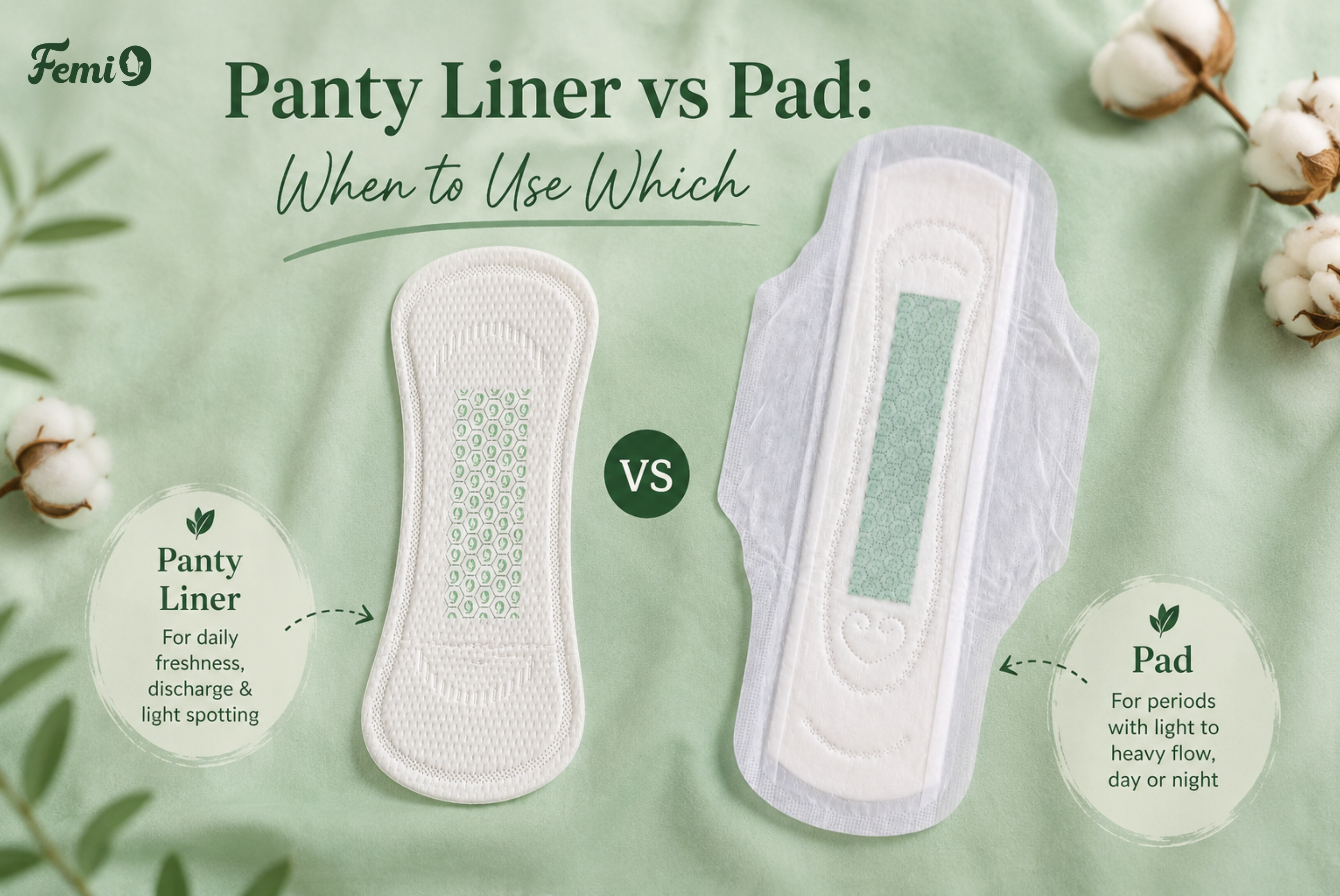
A few things genuinely help. Keep a pad in every bag rather than one bag. Track even the irregular dates, because irregularity has patterns of its own. And on the light or uncertain days, ultra-thin 180mm pads are discreet enough for everyday wear without the bulk. For the heavy, arrived-out-of-nowhere days, 330mm XL pads give you the coverage to stop thinking about it, and 290mm large pads cover the middle ground. If your skin reacts badly during long unpredictable stretches, the organic cotton range uses a breathable organic cotton top sheet with an absorbent core infused with aloe vera and corn extracts — which matters when you may be wearing protection on days you are not even sure you need it.
None of this fixes the underlying cause. It just takes one worry off a list that is already long enough.
Frequently Asked Questions
Why is my period late if I am not pregnant?
The most common explanations are stress, PCOS, thyroid dysfunction, significant weight change, hormonal contraception, perimenopause, or a recent illness or disrupted sleep. A single late period is rarely a concern; a repeating pattern is worth investigating with a doctor.
How many days delay in periods is normal?
A delay of up to about a week is generally considered within normal variation, and cycles anywhere from 21 to 35 days are normal. It becomes worth medical attention when you have missed three consecutive periods, or when your cycle length regularly falls outside that range.
Can stress really delay your period?
Yes, and the mechanism is well documented. Sustained stress raises cortisol, which suppresses the hypothalamic signals that trigger ovulation. In more severe cases this is diagnosed as functional hypothalamic amenorrhoea, associated with psychological stress, weight loss and excessive exercise.
What causes irregular periods in unmarried girls and young women?
The same causes apply regardless of marital status — most commonly PCOS, thyroid problems, academic or work stress, and weight change. Irregular cycles are also entirely expected in the first two to three years after periods begin, while the cycle is still settling.
Does PCOS always mean irregular periods?
Not always, but irregular or absent cycles are one of its core diagnostic features, alongside signs of raised androgens and polycystic ovarian morphology on ultrasound. Diagnosis requires two of those three, so a doctor will usually order blood tests and a scan rather than judging on cycle length alone.
Which sanitary pad is best when my periods are unpredictable?
Keep a range rather than one size. Femi9’s ultra-thin 180mm pads suit light or uncertain days, 290mm large pads handle a regular flow, and 330mm XL pads cover heavy or overnight days. If you are new to organic cotton, the 3-pad trial pack is a low-commitment way to test how your skin responds.
Can irregular periods be cured?
In most cases they can be managed effectively, and often resolved, once the cause is identified. Thyroid disorders respond well to medication, stress-related amenorrhoea usually reverses when the stressor and energy balance are addressed, and PCOS is manageable through a combination of lifestyle changes and medical treatment. The essential step is diagnosis rather than guesswork.
Final Thoughts: Your Cycle Is Information, Not a Verdict
An irregular cycle is not a personal failing, a punishment, or something to be quietly ashamed of. It is your body sending a message in the only language it has. Sometimes that message is simply this month has been hard. Sometimes it points to something specific and treatable, like a thyroid that needs support or PCOS that deserves proper management.
Either way, you are allowed to ask. You are allowed to write the dates down, take them to a doctor, and expect to be taken seriously. Far too many women in India spend years assuming irregular periods are just their lot, and only discover otherwise when something else forces the question.
In the meantime, be kind to yourself on the unpredictable days. Femi9 makes organic, chemical-free, rash-free sanitary pads designed for real bodies and real, imperfect cycles — soft, breathable, and there whenever your period decides to arrive. You can read more honest period guidance on the Femi9 blog, find practical answers in our FAQ section, learn what Femi9 stands for, or get in touch if you have a question you would rather ask directly.
Your cycle does not have to be perfect to be healthy — but it does deserve to be understood.
A gentle note: if a late period is causing real distress, or if worry about your body has started affecting your daily life, please talk to someone you trust or call Tele-MANAS, the Government of India’s free 24×7 mental health helpline, on 14416. Asking for support is never an overreaction.
References
• NHS — Irregular Periods: https://www.nhs.uk/symptoms/irregular-periods/
• NHS — Periods and Fertility in the Menstrual Cycle: https://www.nhs.uk/conditions/periods/fertility-in-the-menstrual-cycle/
• Cleveland Clinic — Irregular Periods (Abnormal Menstruation): https://my.clevelandclinic.org/health/diseases/14633-abnormal-menstruation-periods
• JAMA Network Open (2024) — Prevalence, Phenotypes and Comorbidities of PCOS Among Indian Women: https://www.ncbi.nlm.nih.gov/pmc/articles/PMC11581580/
• Health-Related Quality of Life Among Indian Women With PCOS, Kolkata: https://www.ncbi.nlm.nih.gov/pmc/articles/PMC11979959/
• Journal of Obstetrics and Gynecology of India — Role of Thyroid Dysfunction in Patients With Menstrual Disorders, Delhi: https://link.springer.com/article/10.1007/s13224-014-0650-0
• Endocrine Society Clinical Practice Guideline — Functional Hypothalamic Amenorrhea: https://academic.oup.com/jcem/article/102/5/1413/3077281
• Functional Hypothalamic Amenorrhea and Its Influence on Women’s Health (Review): https://www.ncbi.nlm.nih.gov/pmc/articles/PMC4207953/
• NFHS-4 and NFHS-5 Analysis — Anaemia Among Women of Reproductive Age in India: https://pmc.ncbi.nlm.nih.gov/articles/PMC10860231/
• Tele-MANAS, Ministry of Health & Family Welfare, Government of India (Helpline 14416): https://telemanas.mohfw.gov.in/